
How Does a Murti Become a Living Deity?
Introduction: From Crafted Form to Sacred Presence
At first encounter, a murti—a sculpted image found in Hindu temples—may appear to be stone, metal, or wood shaped into a recognizable form. To an external observer, it may seem symbolic or representational. Within Hindu traditions, however, a consecrated murti is understood not merely as a symbol, but as a living locus of divine presence.
This understanding raises a frequently asked and often misunderstood question: How does a murti transition from a crafted object into a living deity? The answer lies at the intersection of ritual practice, theological reasoning, philosophical worldview, and sustained devotional engagement.
What Is a Murti, Really?
A murti is not regarded as divine simply because of its material form or artistic craftsmanship. It is consecrated as part of a ceremony. Prior to consecration, it is treated as a physical object—carved by artisans, transported, and installed without ritual reverence.
- The murti is a medium, not the deity itself
- Its form follows precise iconographic prescriptions (śilpa śāstra)
- Posture, gesture (mudrā), and proportion encode philosophical meaning
At this stage, the murti is intentionally prepared but not yet spiritually activated.
A Murti Is Not an Idol: Clarifying a Common Misconception
The term “idol” is frequently used to describe Hindu images of worship, yet within Hindu philosophical frameworks this label is conceptually inaccurate and historically misleading.
An idol, in its classical sense, refers to an object believed to be divine in and of itself—where material form is mistaken for ultimate reality. Hindu traditions explicitly reject this notion.
A murti, by contrast, is a manifest form (sākāra) intentionally prepared to serve as a focal point for divine presence.
- A murti is not worshipped as mere matter
- It does not possess inherent divinity by default
- It does not replace or limit the infinite nature of the divine
Rather, the murti functions as an interface for relational engagement. Just as a flag represents a nation without being the nation itself, or a photograph evokes presence without replacing a person, the murti facilitates orientation toward the divine without claiming exclusivity over it.
A murti does not assert, “This object is God.”instead it conveys, “Through this form, the divine may be encountered.”
The Central Rite: Prāṇa Pratiṣṭhā
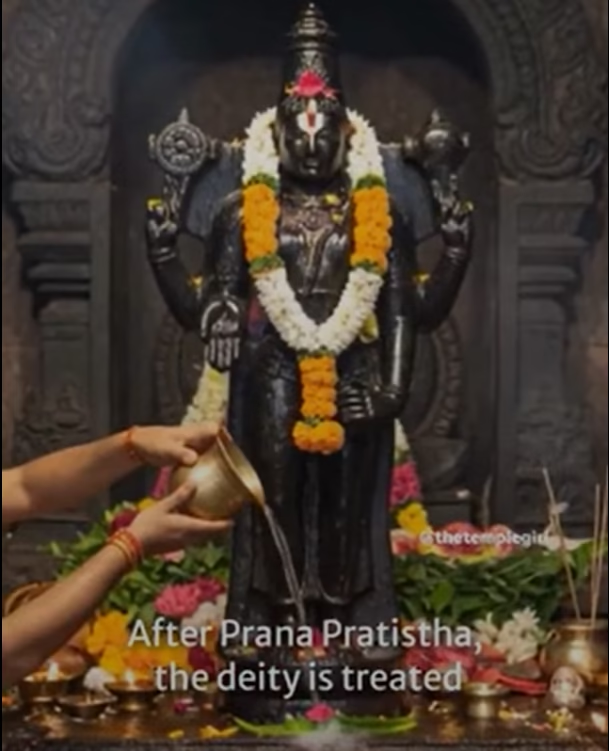
The transformation of a murti into a sacred presence occurs through prāṇa pratiṣṭhā, a consecration ritual meaning “the establishment of life force.”
This ritual is understood not as symbolic theater, but as a deliberate invocation inviting divine presence to reside in the murti.
- Recitation of Vedic and tantric mantras
- Ritual purification of the image and space
- Invocation of cosmic principles
- The ceremonial “opening of the eyes”
Following consecration, the murti’s status changes—it is approached not as an object, but as a living presence.
Is the Deity Confined to the Image?
A common misunderstanding is that divine presence within a murti implies confinement. Hindu theology carefully distinguishes between localization and limitation.
The divine remains infinite and omnipresent, while the murti functions as a localized access point—analogous to electricity illuminating a bulb or sound transmitted through a receiver.
Living Relationship: Daily Worship and Ritual Care
Once consecrated, the murti participates in an ongoing relational framework. Daily rituals may include awakening, bathing, adorning, feeding, honoring, and resting the deity.
From an academic perspective, this reflects bhakti-oriented religiosity, where devotion is cultivated through intimacy, repetition, and embodied practice.
Philosophical Foundations
Murti consecration aligns coherently with broader Hindu philosophical assumptions, including Brahman as the ground of all existence, the legitimacy of both form (sākāra) and formlessness (nirākāra), and the principle of darśan—seeing and being seen by the divine.
Diversity Across Traditions
While ritual details vary across Shaiva, Vaishnava, and Shakta traditions, the underlying principle remains consistent: sacred presence is invoked through consecration and sustained through worship.
Why This Matters Today
In contemporary contexts, murti worship provides tangible structure for spiritual discipline, emotional intimacy with the sacred, and continuity of tradition across generations.
Video
Conclusion: From Object to Presence
A murti becomes a living deity not through assumption, but through intentional design, ritual consecration, philosophical coherence, and sustained devotional care.
Situated at the convergence of art, ritual, metaphysics, and lived practice, the murti reflects a worldview in which the sacred is not distant—but invited, encountered, and nurtured daily.
Credits
Video is from an Instagram post (sorry could not find the accurate handle which posted this video first)
